

CBD/THC Balance Oil
ExpectedMonday January 6th
Symptom monitoring with the Script Assist patient app.
Script Assist was designed to bridge the gaps in medical cannabis prescribing, ensuring the patients who need it can access it and the doctors who prescribe it can remain confident and compliant. What started as software to enable prescriptions grew into a fully fledged tele-health platform used by private clinics around the UK, and then into a SaaS provider.
When I joined, Script Assist was in its bare bones. There was an MVP prescription facilitating web app for doctors, aimed at solving where the drugs would come from. But for patients to be safe and doctors to be compliant, medical professionals needed to be confident that the medicine was working (or not). Patients needed a way to track their prescriptions and symptoms, and doctors needed a way to monitor progress over time as well as prescribe the cannabis.
Whilst there was no legal requirement to monitor symptoms, there is a legal requirement for a doctor to demonstrate the treatment is working to continue prescribing.
Ensuring the design had low cognitive load was key for symptom tracking as users were often in pain, fatigued, and dealing with any array of problems. Symptom tracking needed to be easy enough for patients to understand it with minimal friction but accurate enough for it to be valuable to doctors. I started the designs off using the Numeric Rating Scale (0-10), but user testing quickly demonstrated that whether 0 or 10 was high or low was very much up for debate. This was meant to be a check-in, not a confusing form. So instead, I reverse-codified the scale to match smiley faces, inline with clinical groupings. This was far easier to understand. There was no debate as to whether a sad face meant good or bad.
The results still came through to the doctors numerically, and they were happy to be given groups instead of a specific number out of 10. This reduced the cognitive load of answers from 10 to 5, providing a compromise so that both the doctor and patient got the value they needed from it. We added the ability for patients to write an optional note, but I chose against making that a required field as to not add pressure to the experience (before knowing how hard it would be for them to track their symptoms in the first place). This catered to patients and doctors in situations that found extra help beneficial as well as scenarios where it would have been more of a burden than not.
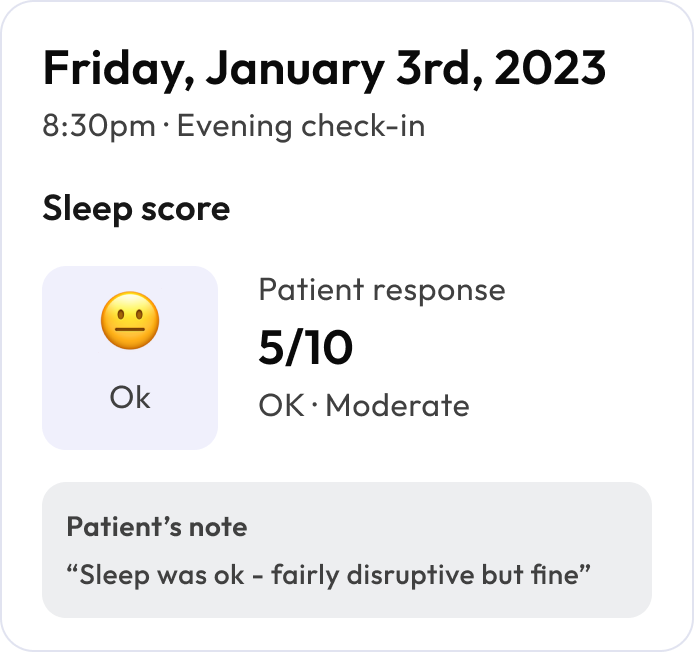
On the doctor side, the check-in surfaces as a clear symptom card alongside the prescription, so progress over time is easy to read at a glance and confident re-prescribing decisions can be made.
This feature built a lot of trust and confidence with doctors. Focus groups revealed far more interest than before and more clinics wanted to sign on to use the product. 100% of patients who were given the app to use were able to use it without any issues, and doctors found the insights valuable, enabling them to confidently re-prescribe as well as offer treatments to new patients. This opened up conversations and potential for what Script Assist could develop into, starting us on the path towards developing a full tele-health service.