Giving care experts one screen to run a customer from
Giving care experts one screen to run a customer from
Actions, calls and key documents for those navigating care.
Actions, calls and key documents for those navigating care.
Overview
Overview
Overview
KareHero connects family carers with a real human — a care expert who helps them navigate one of the hardest stretches of their life. Funding crises, hospital discharges, a dementia diagnosis landing out of nowhere. The product’s job is to make those human interactions count.
The problem was that the humans had nowhere good to work. Care experts were running their entire workflow across multiple tools, tracking customers in Excel spreadsheets opened in incognito mode, for information that already lived somewhere else in our own product. Every minute spent on that admin was a minute not spent with a carer.
This is the story of pulling that work back into the product — building Actions, Calls and Key Documents so a care expert can run a customer from one screen instead of six.
KareHero connects family carers with a real human — a care expert who helps them navigate one of the hardest stretches of their life. Funding crises, hospital discharges, a dementia diagnosis landing out of nowhere. The product’s job is to make those human interactions count.
The problem was that the humans had nowhere good to work. Care experts were running their entire workflow across multiple tools, tracking customers in Excel spreadsheets opened in incognito mode, for information that already lived somewhere else in our own product. Every minute spent on that admin was a minute not spent with a carer.
This is the story of pulling that work back into the product — building Actions, Calls and Key Documents so a care expert can run a customer from one screen instead of six.
Team
Team
Team
Product
Product
1
1
Engineering
Engineering
3
3
Design
Design
1
1
The problem
The problem
The problem
Meaningful interactions was the theme of the quarter. The headline goal was engagement — getting carers into the product more often, and making the time care experts spend with them actually count. The instinct with a target like that is to go straight for the number. But the interactions weren’t being lost because carers didn’t need help. They were being lost because three structural problems were actively blocking them.
Meaningful interactions was the theme of the quarter. The headline goal was engagement — getting carers into the product more often, and making the time care experts spend with them actually count. The instinct with a target like that is to go straight for the number. But the interactions weren’t being lost because carers didn’t need help. They were being lost because three structural problems were actively blocking them.
The first was the tooling gap. Our care experts are the heart of the product — the people in touch with customers the most, and the ones with the most empathy for them. And we’d given them tools so insufficient they were hacking around us with spreadsheets. Building a shortlist for a single customer took 2.5 hours, partly because the care expert had to impersonate the user to read their form answers, then context-switch across five-plus tools to pull it together.
The second was repetition. Every form asked who you were caring for. The same information got requested across multiple touchpoints. When you do that to people, you don’t just waste their time — you teach them that engaging with the product is tedious, and they disengage.
The first was the tooling gap. Our care experts are the heart of the product — the people in touch with customers the most, and the ones with the most empathy for them. And we’d given them tools so insufficient they were hacking around us with spreadsheets. Building a shortlist for a single customer took 2.5 hours, partly because the care expert had to impersonate the user to read their form answers, then context-switch across five-plus tools to pull it together.
The second was repetition. Every form asked who you were caring for. The same information got requested across multiple touchpoints. When you do that to people, you don’t just waste their time — you teach them that engaging with the product is tedious, and they disengage.
The third was a generic experience that treated every carer the same, no matter how different their situation. But that’s a separate strand of work. This case study is about the first blocker: giving the care experts a real place to work, and in doing so, killing a big chunk of the repetition too.
The third was a generic experience that treated every carer the same, no matter how different their situation. But that’s a separate strand of work. This case study is about the first blocker: giving the care experts a real place to work, and in doing so, killing a big chunk of the repetition too.
We’re talking about builders waking up at 4am, saying their good mornings and goodbyes in a language that isn’t english with barely a coffee in their system before pulling a 12 hour shift. We’re talking about not-so-stay-at-home parents taking odd substitute shifts at the local school when their teachers are going through rounds of the flu, returning home to a busy school of their own.
We needed a way for our users to avoid the miscommunications and late collection of important documents from a group of people who struggled to answer the phone at any given time.
Image
Vision
Vision
One screen. A care expert opens a customer’s control panel and is oriented in seconds, not minutes — they can see the care circle, its status, its documents, its calls and the follow-ups they owe. No impersonation. No spreadsheet. No hunting across tabs.
And the follow-ups a care expert creates don’t vanish into an email the carer never opens. They land in the carer’s app as a clear, tappable list — “From your care expert” — so the conversation that happened on the phone actually carries on afterwards.
One screen. A care expert opens a customer’s control panel and is oriented in seconds, not minutes — they can see the care circle, its status, its documents, its calls and the follow-ups they owe. No impersonation. No spreadsheet. No hunting across tabs.
And the follow-ups a care expert creates don’t vanish into an email the carer never opens. They land in the carer’s app as a clear, tappable list — “From your care expert” — so the conversation that happened on the phone actually carries on afterwards.
Research and insights
Research and insights
This work sat on top of a care expert research synthesis. I spoke to the care experts directly — they’re internal, which meant I had the rare luxury of actually talking to my users rather than building empathy profiles second-hand.
I documented the thinking in a set of Linear PRDs so the team could follow the logic from “why this matters” all the way down to interaction detail:
This work sat on top of a care expert research synthesis. I spoke to the care experts directly — they’re internal, which meant I had the rare luxury of actually talking to my users rather than building empathy profiles second-hand.
I documented the thinking in a set of Linear PRDs so the team could follow the logic from “why this matters” all the way down to interaction detail:

Post-call actions were getting asked for in conversation and then lost — to Slack, to email, to memory. There was no system. Baseline tracking of follow-ups was roughly 0%.
Post-call actions were getting asked for in conversation and then lost — to Slack, to email, to memory. There was no system. Baseline tracking of follow-ups was roughly 0%.
Shortlists alone took 2.5 hours per customer, and a chunk of that was impersonating the user just to read their data.
Shortlists alone took 2.5 hours per customer, and a chunk of that was impersonating the user just to read their data.
Carers saw nothing after a call unless they happened to check their email. The thread of the relationship just dropped.
Carers saw nothing after a call unless they happened to check their email. The thread of the relationship just dropped.
The same information was being collected over and over, which ate care expert time on the back end too — validating data and correcting users’ missteps.
The same information was being collected over and over, which ate care expert time on the back end too — validating data and correcting users’ missteps.
Constraints and solutions 1
Constraints and solutions 1
Four things that look like one thing, but aren’t. Calls, call notes, actions and documents kept getting talked about as if they were the same kind of object. They’re not, and conflating them would have baked confusion into the data model and the navigation.
Four things that look like one thing, but aren’t. Calls, call notes, actions and documents kept getting talked about as if they were the same kind of object. They’re not, and conflating them would have baked confusion into the data model and the navigation.
So before any screens, I wrote the information architecture down. Four independent entities, connected by reference where it makes sense. A call is a scheduled event with a lifecycle — it is not an action and doesn’t belong in a todo list. Call notes always attach to a call. Actions can come from a call, a care expert or a carer, but don’t need a call to exist. Documents live on their own. When the full chain exists it runs Call → Call notes → Actions → Documents — but that’s the happy path, not a dependency chain. Getting that right up front let three features ship as one coherent system instead of three overlapping ones.
So before any screens, I wrote the information architecture down. Four independent entities, connected by reference where it makes sense. A call is a scheduled event with a lifecycle — it is not an action and doesn’t belong in a todo list. Call notes always attach to a call. Actions can come from a call, a care expert or a carer, but don’t need a call to exist. Documents live on their own. When the full chain exists it runs Call → Call notes → Actions → Documents — but that’s the happy path, not a dependency chain. Getting that right up front let three features ship as one coherent system instead of three overlapping ones.
Constraints and solutions 2
The upload trap. There are two completely different kinds of file in this system. The ephemeral attachment — a photo of a prescription a carer snaps onto their own action, which should die with that action. And the permanent Key Document — the funding guide or power-of-attorney form the family needs to keep forever. The risk was a carer uploading an important document onto a throwaway action, then losing it when the action got cleared.
The upload trap. There are two completely different kinds of file in this system. The ephemeral attachment — a photo of a prescription a carer snaps onto their own action, which should die with that action. And the permanent Key Document — the funding guide or power-of-attorney form the family needs to keep forever. The risk was a carer uploading an important document onto a throwaway action, then losing it when the action got cleared.
The solution was to make it impossible by design, not by warning. Carers can’t attach files to actions a care expert created. If a care expert needs a document, they set the action’s “Link to” destination to Key Documents — the carer’s button becomes “Upload document”, the file lands permanently in Key Documents and auto-links back to the action. The carer literally cannot put it in the wrong place, because the wrong place isn’t offered. Don’t write a help doc telling people not to make a mistake — remove the path to the mistake.
The solution was to make it impossible by design, not by warning. Carers can’t attach files to actions a care expert created. If a care expert needs a document, they set the action’s “Link to” destination to Key Documents — the carer’s button becomes “Upload document”, the file lands permanently in Key Documents and auto-links back to the action. The carer literally cannot put it in the wrong place, because the wrong place isn’t offered. Don’t write a help doc telling people not to make a mistake — remove the path to the mistake.

Execution: care experts (admin side)
Execution: care experts (admin side)
Everything lives in cards on the care recipient control panel, in the same visual language as the rest of the page. One shared “Add” button sits top-right — pressing it opens the action drawer directly, since actions are the primary job, and a caret reveals Call notes and Document as the other options.
Everything lives in cards on the care recipient control panel, in the same visual language as the rest of the page. One shared “Add” button sits top-right — pressing it opens the action drawer directly, since actions are the primary job, and a caret reveals Call notes and Document as the other options.
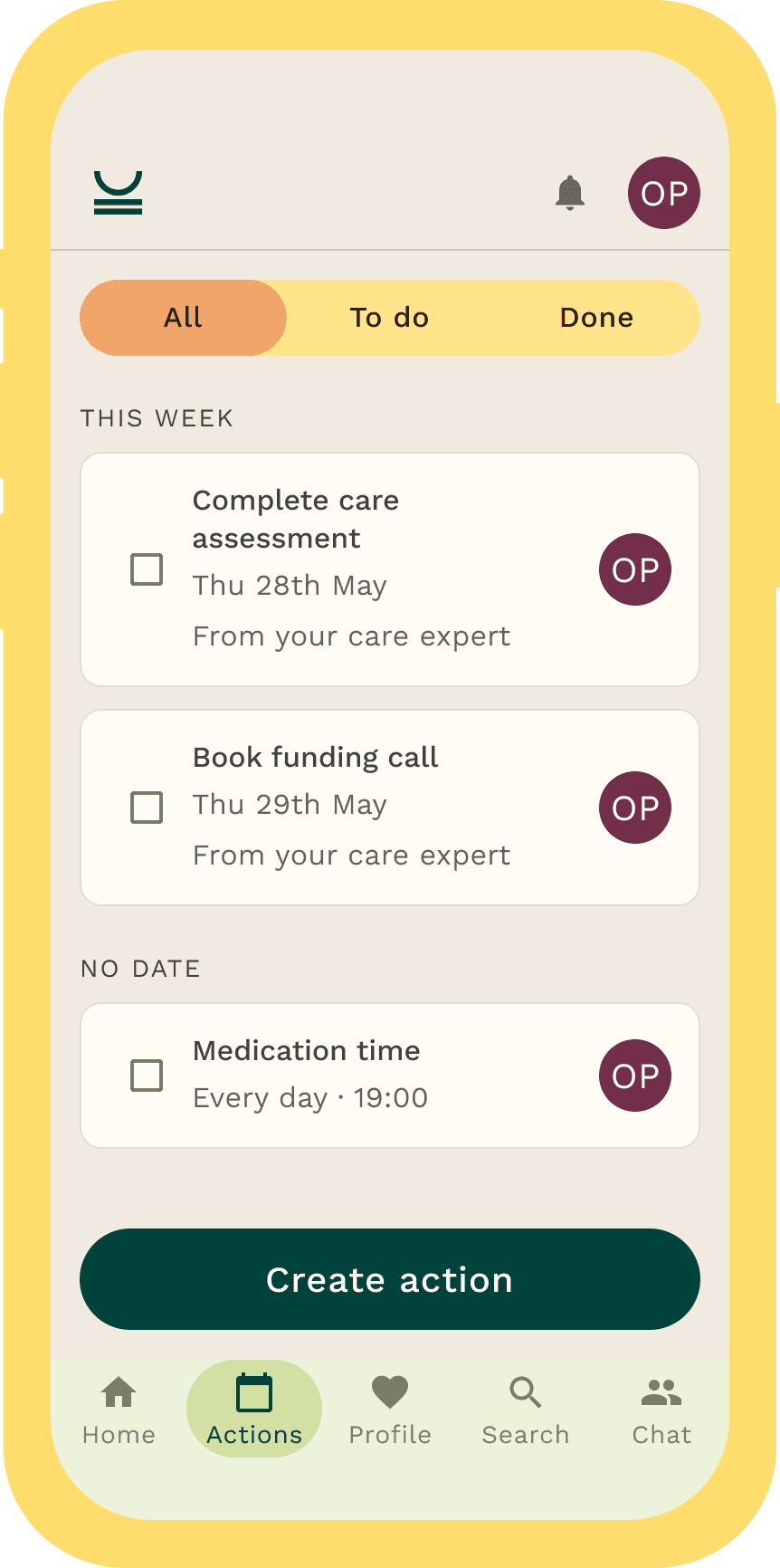
Actions is a proper task tool. Create, edit, reassign, delete. Optional due dates. A recurring toggle that auto-generates the whole series. A “view before you edit” read mode so a care expert doesn’t fat-finger someone else’s care plan. The container defaults to the week ahead — overdue first, then soonest due, then undated — with a “show month” toggle. Completed actions hide by default, because the care expert gets a notification when a carer ticks something off.
Call notes lets a care expert log what happened after a conversation. Paste the Calendly link and it pulls the call metadata in automatically — date, duration, who was on it — so the notes are tied to the specific call that produced them. Free text, not a form.
Key Documents is a simple, deliberate upload. Name, optional tags, an optional note. Visible to the whole care circle. No versioning, no in-app editing — that restraint is the point for V0.
Actions is a proper task tool. Create, edit, reassign, delete. Optional due dates. A recurring toggle that auto-generates the whole series. A “view before you edit” read mode so a care expert doesn’t fat-finger someone else’s care plan. The container defaults to the week ahead — overdue first, then soonest due, then undated — with a “show month” toggle. Completed actions hide by default, because the care expert gets a notification when a carer ticks something off.
Call notes lets a care expert log what happened after a conversation. Paste the Calendly link and it pulls the call metadata in automatically — date, duration, who was on it — so the notes are tied to the specific call that produced them. Free text, not a form.
Key Documents is a simple, deliberate upload. Name, optional tags, an optional note. Visible to the whole care circle. No versioning, no in-app editing — that restraint is the point for V0.
Execution: carers
Execution: carers
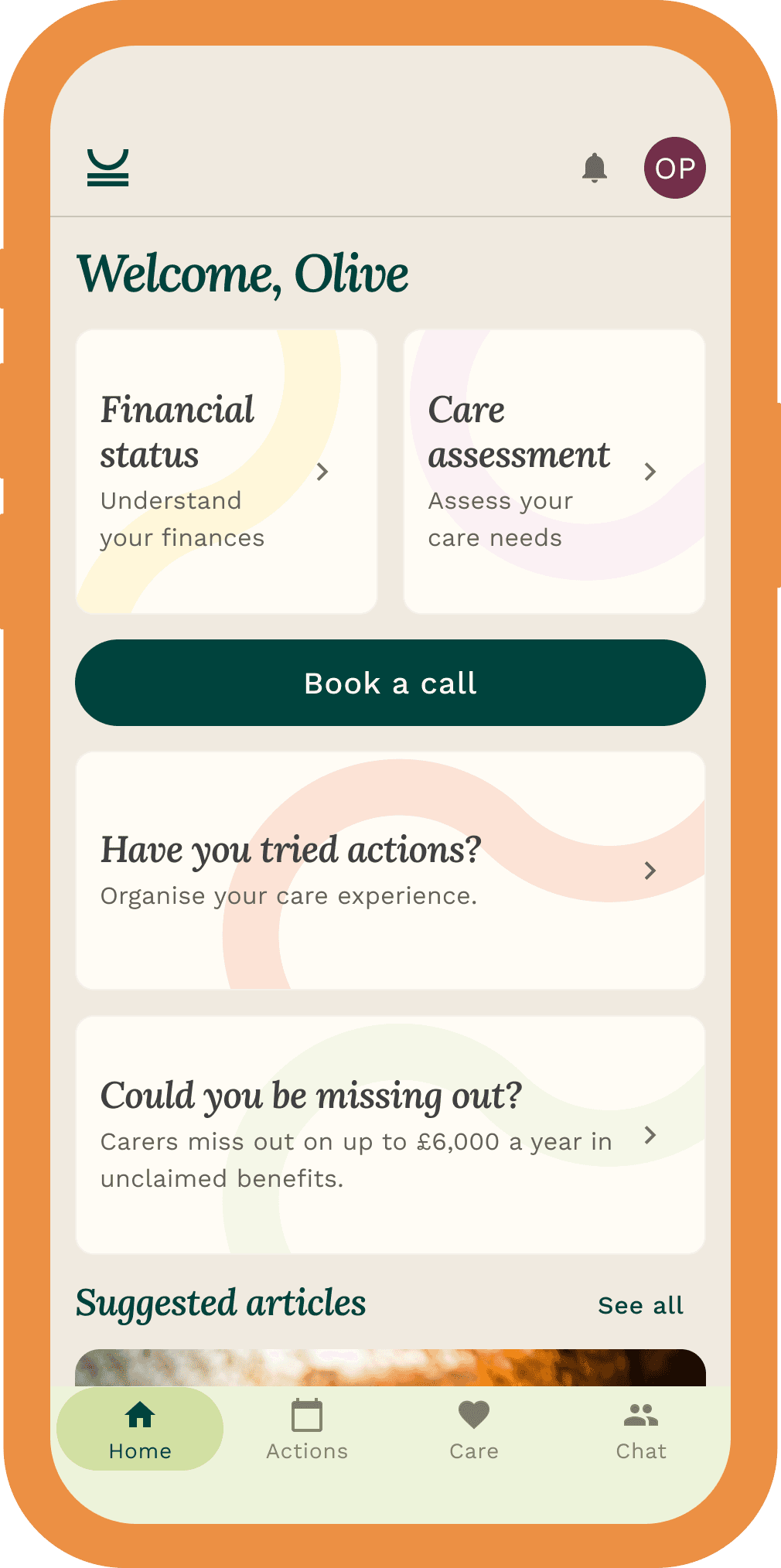
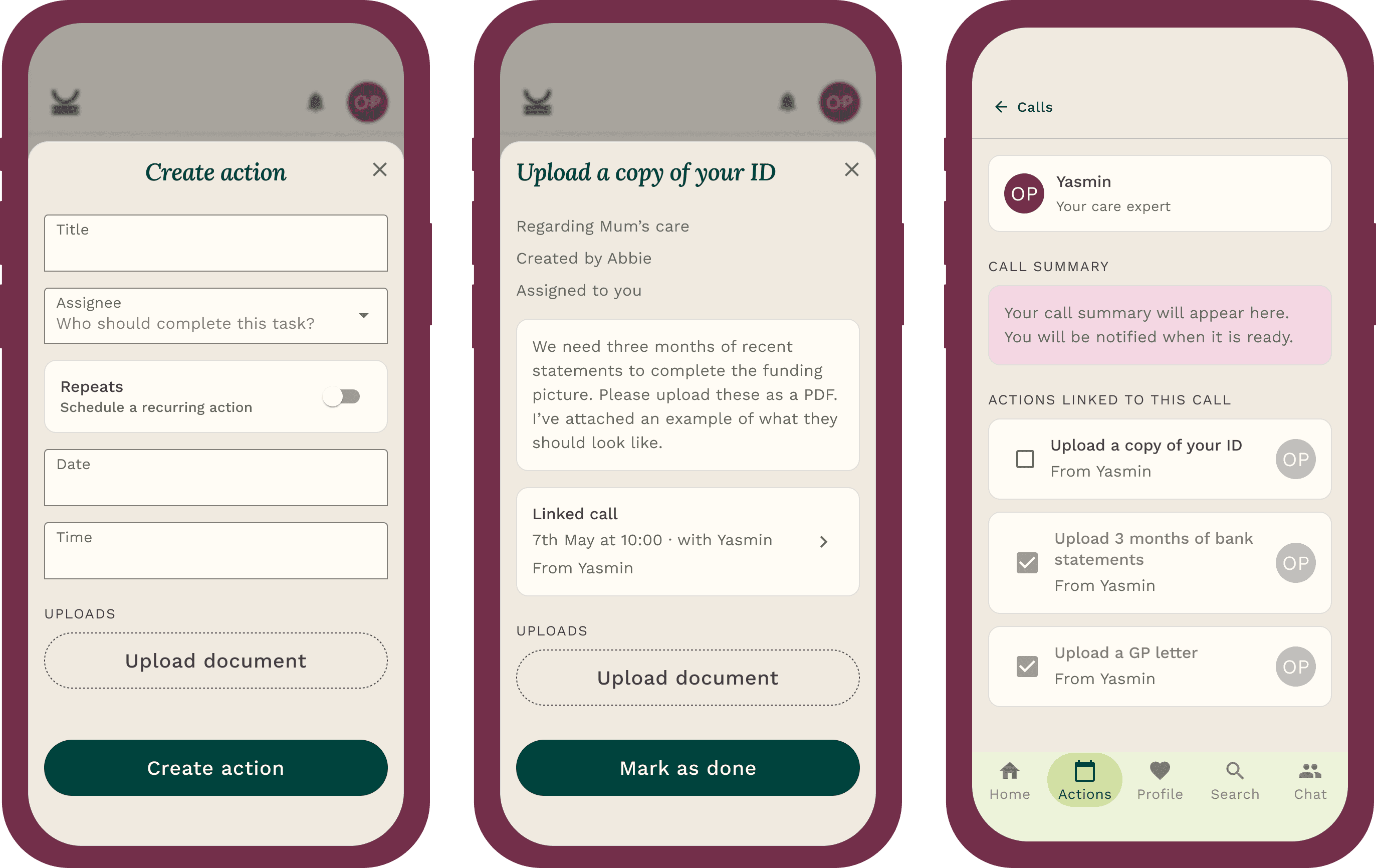
The carer side is where the meaningful interaction actually lands. Actions from a care expert show up in the carer’s Actions tab with clear attribution and, where relevant, a tappable link back to the call they came from (“from your call on 21 April”). They can view, tap the deep-link, and mark things complete — but they can’t edit or delete what they didn’t create.
Calls get a home inside the Care Hub — upcoming calls to book or reschedule, past calls with their notes attached, and the actions linked to each one. The phone call stops being a thing that happens and then evaporates. It becomes a record the carer can return to.
No new tab. Five tabs stay five tabs. Calls slots into the Care Hub, Actions stays the checklist it already was. The architecture got richer without the carer’s mental model getting heavier.
The carer side is where the meaningful interaction actually lands. Actions from a care expert show up in the carer’s Actions tab with clear attribution and, where relevant, a tappable link back to the call they came from (“from your call on 21 April”). They can view, tap the deep-link, and mark things complete — but they can’t edit or delete what they didn’t create.
Calls get a home inside the Care Hub — upcoming calls to book or reschedule, past calls with their notes attached, and the actions linked to each one. The phone call stops being a thing that happens and then evaporates. It becomes a record the carer can return to.
No new tab. Five tabs stay five tabs. Calls slots into the Care Hub, Actions stays the checklist it already was. The architecture got richer without the carer’s mental model getting heavier.
IN FLIGHT
Honest note: this is in-flight work and being built. This is what we defined success as, and why these are the right things to watch.

Success
Success
Zero impersonation for actions. Care experts create and manage every follow-up from the control panel, with no need to log in as the user to read their data. That alone claws back a slice of the 2.5 hours a shortlist was costing.
Zero impersonation for actions. Care experts create and manage every follow-up from the control panel, with no need to log in as the user to read their data. That alone claws back a slice of the 2.5 hours a shortlist was costing.
100% follow-up capture. Every post-call action item lands as a tracked action. Baseline today is roughly 0% — it’s all informal.
100% follow-up capture. Every post-call action item lands as a tracked action. Baseline today is roughly 0% — it’s all informal.
Adoption as the real test. All five care experts using Actions as their primary follow-up method within two weeks. If they’re still emailing follow-ups, it hasn’t worked, and I’d rather measure it that bluntly.
Adoption as the real test. All five care experts using Actions as their primary follow-up method within two weeks. If they’re still emailing follow-ups, it hasn’t worked, and I’d rather measure it that bluntly.
Impact
Impact
The point was never the features. It was the theme underneath them: meaningful interactions. The engagement it was meant to drive — and the realisation that you don’t move a number like that by chasing it directly. You move it by removing the structural things blocking it.
Give care experts a real place to work and you hand back the capacity they were losing to spreadsheets and impersonation — capacity they can spend on the carers who need them. Pull follow-ups into the app and the relationship survives the end of the phone call. Get the information architecture right once and three features behave like one calm system instead of three noisy ones.
That’s the work I’m proudest of here: not the individual screens, but the decision to stop and map how calls, actions and documents actually relate before drawing a single one. The unglamorous bit is the bit that made the rest hold together.
The point was never the features. It was the theme underneath them: meaningful interactions. The engagement it was meant to drive — and the realisation that you don’t move a number like that by chasing it directly. You move it by removing the structural things blocking it.
Give care experts a real place to work and you hand back the capacity they were losing to spreadsheets and impersonation — capacity they can spend on the carers who need them. Pull follow-ups into the app and the relationship survives the end of the phone call. Get the information architecture right once and three features behave like one calm system instead of three noisy ones.
That’s the work I’m proudest of here: not the individual screens, but the decision to stop and map how calls, actions and documents actually relate before drawing a single one. The unglamorous bit is the bit that made the rest hold together.